Advanced composite laminates and deployable structures are of increasing interest for the design of large-scale systems in the aerospace industry. Due to the inherent viscoelasticity of constituent matrix and the possibility of long-term storage before deployment, composite deployable structures are likely to exhibit more or less stress relaxation under the influence of both time and temperature, which may ultimately degrade their deployment performance. Therefore, it is desirable to develop a reliable and user-friendly method that allows for predicting the viscoelastic stress relaxation behavior of composite deployable structures during the long-term stowage, while being exposed to a serve thermal condition in the space environment.
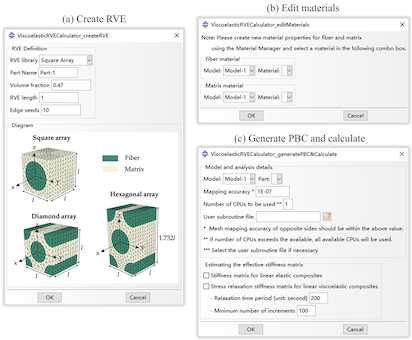
Recently, the research team led by Associate Professor Ning An at SCUAA contribute an original research work that develops a multi-scale modeling method for analyzing the viscoelastic behavior of composite laminates and deployable structures. The paper develops a user-friendly interface plug-in tool within a commercial finite element package Abaqus/CAE to estimate the effective viscoelastic properties of unidirectional composites. The paper then shows that the time-dependent lamina properties output by the plug-in can be subsequently used to model the viscoelastic behavior of arbitrary shaped composite laminates and thin-walled structures at macroscale with the help of some Abaqus built-in functions. Specifically, taking the composite tape-spring hinge as an example, the authors analyzed the effect of long-term stowage on the deployment dynamics of stored strain energy deployable structures. Fig. 1 shows the user interfaces of the plug-in software. Fig. 2 demonstrates the comparison between the plug-in predicted results and the results existing in the literature, which validates the accuracy and efficiency of the software. Fig. 3 gives the deployment snapshots of a composite tape-spring hinge when the deployment starts from two different fully folded configurations. Finally, Fig. 4 illustrates the effect of long-term storage on the deployment performance of the composite tape-spring hinge.
Fig. 1 Tab GUI windows in the plug-in
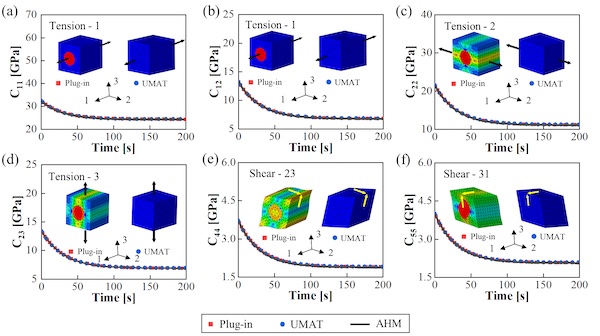
Fig. 2 Comparison between the results predicted by the plug-in tool and the results by other methods reported in literature.
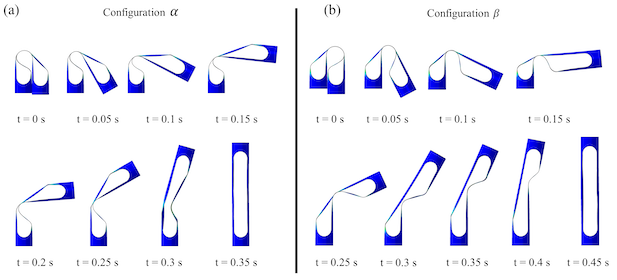
Fig.3 Deployment snapshots of a composite tape-spring hinge that starts from two different fully folded configurations.
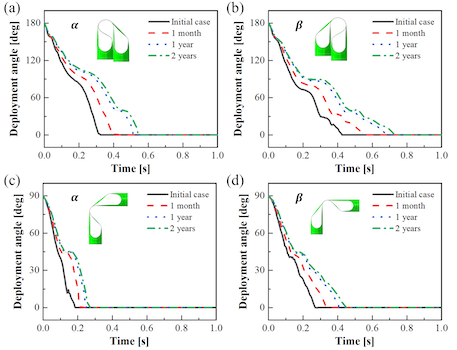
Fig. 4 Effect of long-term storage on the deployment performance of the composite tape-spring hinge.
The results have been published in a top journal in the field of materials engineering Materials & Design (IF: 7.991) titled “Multiscale modeling of viscoelastic behavior of unidirectional composite laminates and deployable structures”. The first and corresponding author is Associate Professor Ning An at SCUAA. Co-authors include Professor Jinxiong Zhou and Ph.D candidate Hao Jin at Xi’an Jiaotong University. Ning An acknowledges the support from the Fundamental Research Funds for the Central Universities (No. YJ2021137), and the Open Project of State Key Laboratory for Strength and Vibration of Mechanical Structures, Xi’an Jiaotong University (No. SV2021-KF-04).
Read the article: https://doi.org/10.1016/j.matdes.2022.110754