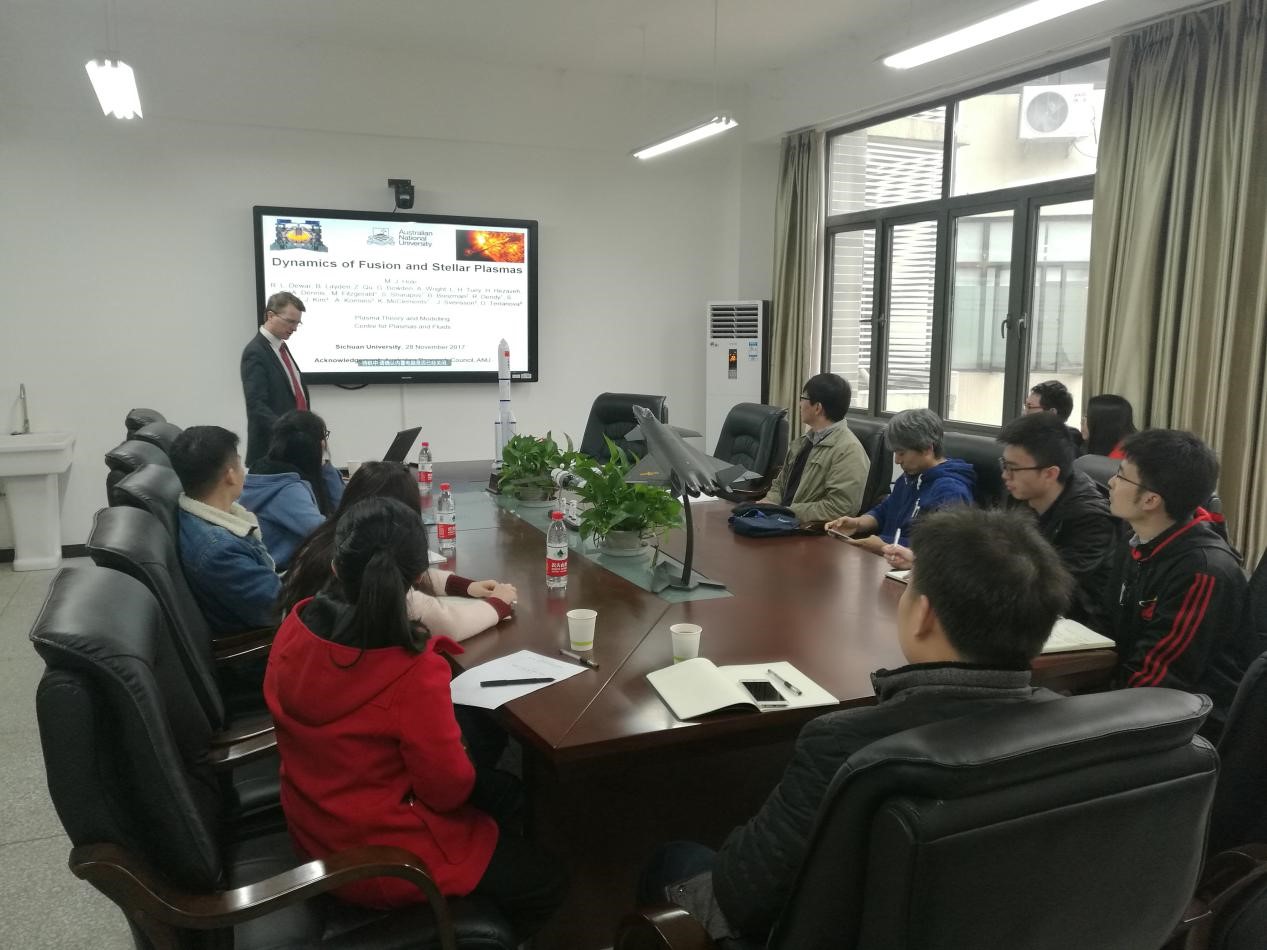
Being invited by Dr. Lei Chang, A/Prof. Matthew Hole from the Australian National University (ANU) gave a lecture in C307 of Binjiang Building at Sichuan University (SCU) on 28 Nov. 2017. The lecture is titled “Dynamics of Fusion and Stellar Plasmas”, and was organized by the Postgraduate Union of School of Aeronautics and Astronautics (SAA).
The lecture covers topics of: (1) the inclusion of anisotropy and flow into tokamak equilibria, stability and wave-particle interaction studies, (2) the calculation of energetic geodesic acoustic modes using fluid theory, (3) the development and implementation of continuum damping in 3D, (4) the application of these tools to high performance discharges on KSTAR, MAST and DIIID tokamaks, and (5) the ongoing development of multi-region magnetohydrodynamics.
During the lecture, A/Prof. Matthew Hole not only introduced the work he has been doing on fusion energy, but also proposed potential collaborations between ANU and SCU on plasma propulsion and other applications regarding aeronautics and astronautics. The lecture attracted more than ten detailed questions and a mutual discussion about twenty minutes. After the lecture, Dr. Lei Chang presented a SCU-120-Aniversary gift to A/Prof. Matthew Hole on behalf of SAA.
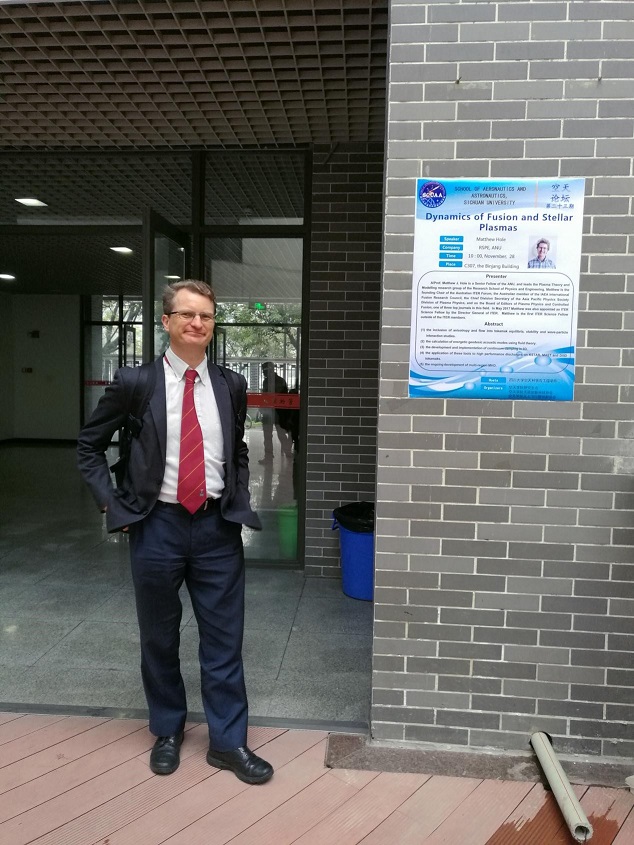
About the presenter:
A/Prof. Matthew Hole is a Senior Fellow of the Australian National University, and leads the Plasma Theory and Modelling research group of the Research School of Physics and Engineering. His principal field of research is magnetohydrodynamics, fluid modelling, and wave analysis of industrial plasmas, fusion plasmas, and space plasmas. Matthew is the founding Chair of the Australian ITER Forum, a research network spanning over 180 scientists and engineers; the Australian member of the IAEA International Fusion Research Council, the Chief Division Secretary of the Asia Pacific Physics Society Division of Plasma Physics, and on the Board of Editors of Plasma Physics and Controlled Fusion, one of three top journals in this field. In May 2017 Matthew was also appointed an ITER Science Fellow by the Director General of ITER. Matthew is the first ITER Science Fellow outside of the ITER members.